
Captive Portal for Starlink: Paid & Controlled WiFi
Turn One Starlink Into Managed Guest WiFi
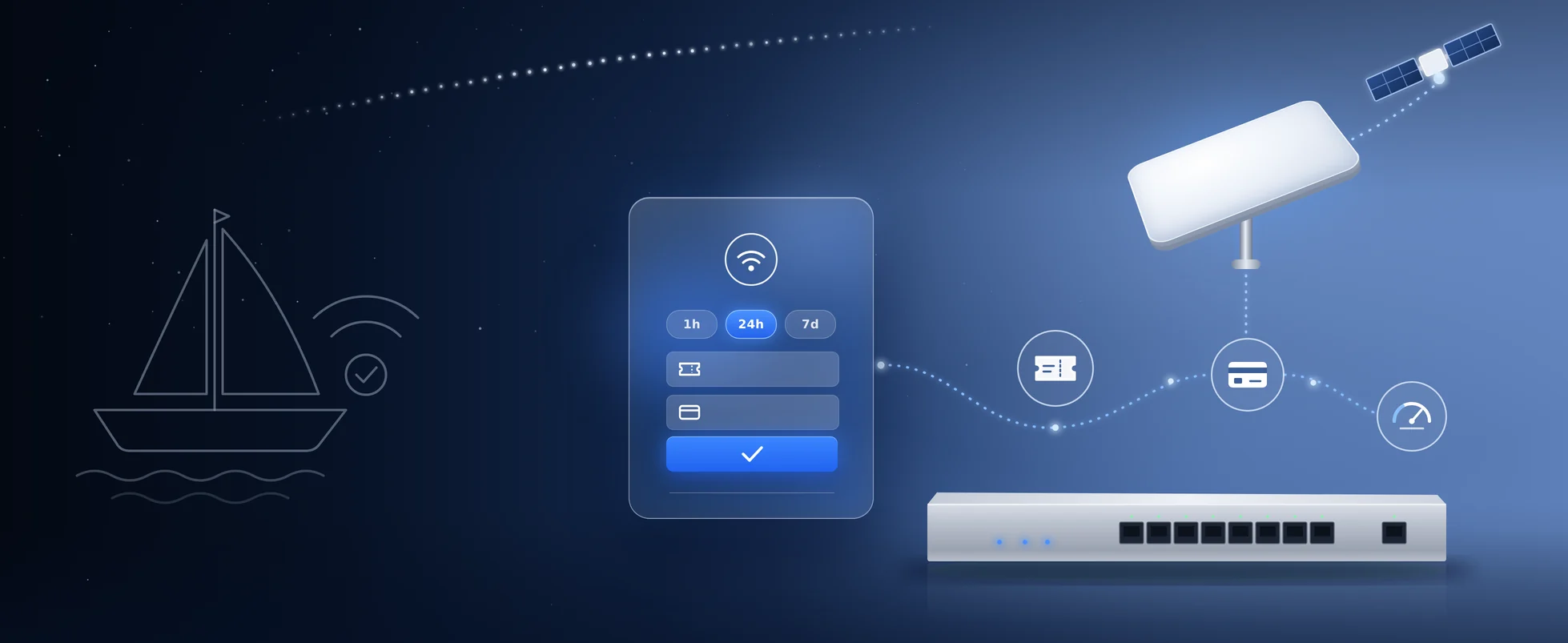
A Starlink captive portal puts a login page between your satellite connection and your guests. Instead of sharing one password with everyone on board or on site, each guest gets access on your terms: a voucher or a paid plan, with time, speed and data limits. You keep control of the bandwidth you pay for, and paid access can help cover the monthly Starlink bill.
Why Starlink Needs Access Control
Starlink brought fast internet to places that never had it: anchorages, campsites, mountain lodges, farms, construction sites and festival fields. It also brought a new problem. One terminal is now shared by dozens of people, and the owner pays for all of it.
Without access control, the same things happen almost everywhere:
- The password spreads. Within a day, guests, neighbors and passing boats all know it.
- A few users eat the connection. One person streaming in 4K or downloading updates slows everyone else down.
- Priority data runs out. Starlink business plans include a set amount of priority data. Every guest’s video comes out of it, and once it is used, speeds drop to a low fallback rate until you buy more.
- Nobody knows who used what. No sessions, no usage figures, no way to spot abuse.
- Private devices share the guest network. Navigation laptops, cameras, card terminals and the owner’s phone sit next to strangers’ devices.
- Nobody pays for it. The operator carries the full Starlink cost while guests use it for free.
The standard Starlink router is built to get people online, not to manage them. It does not offer vouchers, paid plans or per-guest limits. That is the job of a captive portal gateway.
Quick Answer: What You Need
To sell or control WiFi access on Starlink, you need three things:
- A Starlink terminal on a plan that allows hotspot access. See the next section.
- A captive portal gateway such as WAVER, connected to the Starlink by Ethernet. It runs the login page, vouchers, payments and limits.
- Access points for coverage across the boat, campsite or venue. Existing access points can usually stay.
Guests connect to the WiFi, see your branded login page, enter a voucher or pay, and go online with the limits of the plan they chose.
Can You Sell WiFi From Your Starlink?
Yes, with the right plan. Starlink’s Terms of Service do not allow customers to resell access in general. They make one clear exception: customers on a Priority plan may resell access as community WiFi or a hotspot, and the terms name hotel guests and boat passengers as examples.
In practice:
- Residential and Roam plans are not covered by that exception. Selling access on them puts the account at risk.
- Local Priority suits fixed sites and land-based businesses in one country: campsites, lodges, work camps, events and marinas.
- Global Priority suits vessels at sea and businesses that cross borders.
- Maritime providers and other resellers may have their own terms, and some forbid hotspot resale without written consent.
Terms change and differ by country. Check the current Starlink terms for your plan and region before you start charging for access. This page is general information, not legal advice.
How a Starlink Captive Portal Setup Works
The WAVER gateway sits between the Starlink and the guest network. Starlink provides the internet connection; WAVER decides who uses it and how.
A typical setup looks like this:
- Starlink terminal, connected to the gateway by Ethernet (bypass mode is recommended where your kit supports it)
- WAVER captive portal gateway
- PoE switch
- Access points on deck, around the campsite or in the lodge
- Guest devices
The access points broadcast the guest WiFi. WAVER serves the login page, checks vouchers, takes payments, applies speed and data limits, and keeps guests away from the private network. If your access points already work well, they stay.
Why the Captive Portal Should Run Locally on Satellite Internet
Many captive portal services run in the cloud. Every login travels over the satellite link to a remote server and back. On fiber that is fine. On Starlink it creates weak points:
- Link interruptions. Obstructions, motion, heavy weather or a moved dish can break the connection for seconds or minutes. A cloud portal cannot show its login page or check a voucher during that time.
- Wasted data. Every login page, logo and background image is downloaded over your satellite data, again and again.
- Another subscription. Cloud portals usually charge monthly, per site or per access point, on top of the Starlink bill.
- Outside dependency. If the provider has an outage or changes its pricing, your guest WiFi changes with it.
WAVER runs the core functions on the gateway itself: the login page, voucher checks, session handling, speed limits and access rules. The login page loads instantly from the box on board or on site. When the satellite link drops, the portal, vouchers and session records stay on the gateway, so nothing is lost and guests carry on when the connection returns.
Online card and PayPal payments still need the internet to complete, like any online payment. Pre-sold vouchers work regardless.
Access Plans That Work on Starlink
The right plan depends on who your guests are and how long they stay. A WAVER gateway can run several plans side by side.
Examples that work well on Starlink:
- Short pass: one or two hours for marina visitors, day-trippers or café customers.
- Day pass: 24 hours with a data cap, for campers, charter guests and festival visitors.
- Week or stay pass: for longer stays, with a speed limit that keeps the connection fair.
- Free basic tier plus paid premium: a short or slow free session, full speed for paying guests.
- Crew or staff access: longer validity and separate limits, so crew are never stuck behind guests.
- Owner or VIP access: no limits for the people who pay for the boat or the site.
Because guests pay per plan, the Starlink bill becomes a cost the WiFi can cover instead of an expense the business absorbs.
Bandwidth Control: Making One Starlink Serve More Guests
A single Starlink connection is shared by everyone. Bandwidth control decides whether that means thirty happy guests or thirty frustrated ones.
Useful controls on a Starlink network:
- Download and upload speed limits per guest
- Data caps per voucher or plan
- Session time limits and expiry
- Validity that starts at first login
- Device limits per voucher
- Different limits for guests, crew and staff
Data caps matter more on Starlink than on fiber. On a plan billed in data blocks, a cap per voucher turns an unpredictable cost into one you set in advance. Speed limits stop a single device from taking the whole connection.
Taking Payments on a Starlink Network
WAVER supports two ways to charge for access:
- Sell vouchers in person. Print voucher codes and sell them at reception, the bar, the marina office or on board, for cash or through your existing card terminal.
- Pay on the login page. Guests choose a plan and pay by card through Stripe or with PayPal, directly from the captive portal. Access starts as soon as the payment goes through.
Payments go to your own Stripe or PayPal account, with no commission to WAVER.
Keep the Owner’s Network Separate From Guests
On a boat or a remote site, the private network matters: navigation and monitoring systems, security cameras, card terminals, office computers and crew devices. Guests should reach the internet and nothing else.
WAVER keeps the guest network separate from the private network, so visitors cannot see or reach your internal devices or the admin panel. Staff and crew can have their own access rules.
Starlink WiFi by Use Case
Boats, Yachts and Charter Vessels
Charter guests expect WiFi, and crew need it to work. A captive portal lets you include a fair allowance in the charter, sell top-ups, and keep crew and navigation systems on their own network. The WAVER ODY runs on 12 V DC, so it fits on board without an inverter. To sell access on board, you need Global Priority, as Local Priority does not cover use on the water.
Ferries, Tour Boats and Passenger Vessels
Passenger operators can sell short passes for the length of the trip, with speed limits that keep the link usable for everyone on board.
Marinas
Marinas can sell daily, weekly and seasonal passes to berth holders and visiting boats, instead of handing out one password that ends up on every boat in the harbor.
Campsites, Glamping and RV Parks
Campsites often rely on Starlink because fixed lines do not reach the pitches. Daily and weekly vouchers, data caps and speed limits let one or two terminals serve the whole site, and reception sells access like any other extra.
Remote Lodges, Mountain Huts and Eco-Resorts
Guests at remote properties still want to share photos and make calls. A captive portal gives them a branded welcome page and fair access, while the property keeps its booking and payment systems on a separate network.
Work Camps, Mining and Construction Sites
Workers on remote sites want to call home after their shift. Per-person vouchers with fair-use limits stop the connection collapsing every evening and keep site operations on their own network.
Events, Festivals and Pop-Up Venues
Starlink is often the only internet at outdoor events. Separate access for organizers, vendors, press and visitors, with time-limited passes, keeps ticket scanners and card terminals working when the crowd arrives.
Rural Cafés, Shops and Community Hotspots
Where Starlink is the only fast connection in the area, a café or shop on a Priority plan can run a paid community hotspot, selling hourly or daily vouchers to locals and travelers.
Which WAVER Gateway for Your Starlink?
On a single Starlink, the satellite connection is usually the limit, not the gateway. Choose by how many guests will be online at the same time, how the gateway will be powered, and whether you need a second connection.
ODY Series
Up to 200 concurrent users. The WAVER ODY is compact and accepts 12–28 V DC through passive PoE on its WAN port, so it can run from 12 V power on boats, in RVs and at off-grid sites. A good fit for yachts, small campsites, lodges and cafés. From €249.
SmartOne
Up to 500 concurrent users. The WAVER SmartOne is the step up from ODY for busier sites, with quad-core CPU and more user capacity. A good fit for larger campsites, marinas, passenger boats and events. From €479.
ControlX
For large sites and high-capacity installations. WAVER ControlX is dual-WAN, so you can add a second connection such as 4G/5G or a second Starlink.
In all cases, the access points handle wireless coverage, while the WAVER gateway manages guest access from the network level.
Starlink Captive Portal Checklist
Before you start selling or controlling WiFi on Starlink, check these points:
- Is your Starlink on a plan that allows hotspot access?
- Can guests log in with vouchers or pay online?
- Can you set data caps and speed limits per plan?
- Does the login page load locally, even when the satellite link drops?
- Are crew, staff and private systems separated from guests?
- Can you keep your existing access points?
- Can you see active sessions and usage?
- Can the gateway run on the power you have, including 12 V on boats and RVs?
- Does it avoid a monthly fee on top of your Starlink bill?
- Can it handle your peak number of guests?
FAQ – Frequently Asked Questions
Does Starlink have a built-in captive portal?
No. The standard Starlink router provides the connection and WiFi, but it does not offer vouchers, paid plans or per-guest limits. For that, you connect a captive portal gateway such as WAVER.
Can I sell WiFi access from my Starlink?
Starlink’s terms allow customers on Priority plans to resell access as community WiFi or a hotspot, for example to hotel guests or boat passengers. Residential and Roam plans are not covered. Terms change and differ by country. Check the current Starlink terms for your plan and region before you start charging for access. This page is general information, not legal advice. Local rules on public WiFi may also apply.
Does a captive portal work on a moving boat?
Yes. The captive portal runs on the gateway on board, so it works wherever the boat is. To charge for access on board, you need Global Priority, as Local Priority does not cover use on the water.
Can the captive portal gateway run on 12 V power?
Yes. The WAVER ODY accepts 12–28 V DC through passive PoE on its WAN port, so it can be powered from the 12 V system on a boat or in an RV, without an inverter.
What happens to guests when the Starlink connection drops?
The login page, vouchers and sessions are handled by the WAVER gateway, so nothing is lost. Guests have no internet until Starlink reconnects, exactly as they would without a portal.
How many guests can share one Starlink?
It depends on your plan, location and what guests do online. Per-guest speed limits let one terminal serve many more people fairly. For heavy use, add a second Starlink and a dual-WAN gateway.
Can I limit how much data each guest uses?
Yes. Each voucher or plan can carry a data cap as well as time and speed limits, which keeps your Starlink data use predictable.
Can guests pay by card?
Yes. Guests can pay by card through Stripe or with PayPal on the login page, or you can sell printed vouchers in person.
Can I use my existing access points?
Usually, yes. The access points keep providing WiFi coverage while WAVER manages login, vouchers and limits.
Do I need a monthly subscription?
No. WAVER runs the core captive portal features on the gateway. You buy the hardware once; optional services are available but not required.
Can crew and guests have different access?
Yes. Crew, staff and guests can have separate plans with different time, speed and data limits.
Final Thoughts
A Starlink captive portal turns an open, shared satellite connection into managed guest WiFi. Guests get a clear way to connect. You decide who uses the connection, how much they use and what they pay.
On satellite internet, where the portal runs matters. A local gateway keeps the login page fast, protects your data allowance, rides out link drops and adds no second subscription to the Starlink bill.
WAVER gateways bring vouchers, paid access, speed and data limits and network separation to boats, campsites, lodges, work camps and events, using the access points you already have.
Starlink is a trademark of Space Exploration Technologies Corp. WAVER and Wavertech Ltd are not affiliated with, endorsed by or sponsored by Starlink or SpaceX.